Worshiping the God Who Paints Rainbows in the Sky
Worshiping the God Who Paints
Rainbows in the Sky
"The heavens declare the glory of God, and the sky above proclaims his handiwork. . .The law of the Lord is perfect, reviving the soul."
Psalm 19:1, 7a
Introduction
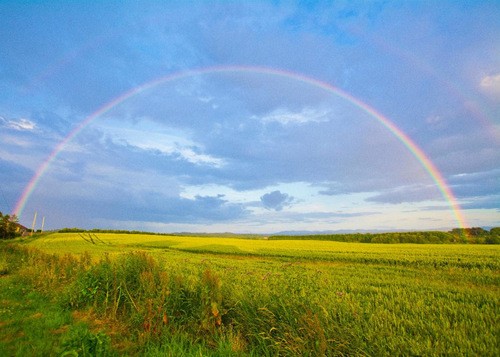
William Wordsworth's powerful words, "My heart leaps up when I behold a rainbow in the sky. . ." recently came to mind when I saw one arching itself across the clouds. The poet wrote of the joy he felt in nature as a child, an attitude he longed never to lose as he became an old man. Wordsworth possessed what is termed a "natural piety," an innate, spiritual reverence for the natural world, which minimized the role of scripture in his Romantic era worldview. [1]
I also recall some memorable childhood encounters with nature. The scent of warm, briny ocean water from the Gulf of Mexico along the seawall in Galveston, Texas, and the faint sweet aroma of dogwood flowers in the Piney Woods of East Texas come to mind. Each of these encounters with the world around me aroused childhood praise for God's creative majesty and still abide within my mind and heart as an adult, now mature in years.
Wordsworth's immortal line "the child is father of the man," reminds me of the importance of cultivating, from earliest days, physical encounters with nature. The moral identity of children is shaped partly by their active experience in the world around them. This truth invites us to consider a question: How well are Christians nurturing their children to honor God by participating actively with them in His creation?
I also recall some memorable childhood encounters with nature. The scent of warm, briny ocean water from the Gulf of Mexico along the seawall in Galveston, Texas, and the faint sweet aroma of dogwood flowers in the Piney Woods of East Texas come to mind. Each of these encounters with the world around me aroused childhood praise for God's creative majesty and still abide within my mind and heart as an adult, now mature in years.
Wordsworth's immortal line "the child is father of the man," reminds me of the importance of cultivating, from earliest days, physical encounters with nature. The moral identity of children is shaped partly by their active experience in the world around them. This truth invites us to consider a question: How well are Christians nurturing their children to honor God by participating actively with them in His creation?
A double-edged moral problem:
physically and spiritually inactive children
physically and spiritually inactive children
It is interesting to me that Wordsworth's engagement with nature was focused on the miracle of ordinary things minus any direct application of God's word, while mine included the miracle of God's extraordinary presence in all that I was experiencing. I believe that both the physical and spiritual, as well as the mental and emotional, are keys to the total moral development of children. We see two present concerns regarding this holistic development, however.
Insufficient physical outdoor activity. A recent longitudinal study reveals the troubling truth about a generation of children across the globe. [2] Current research demonstrates the startling fact that seventy-six percent of boys and nearly eighty-five percent of girls are insufficiently active. They are physically inactive and spend less time in the outdoors than past generations. The culprit has been indoor screen-time with television and gaming devices that have replaced outdoor activities.
Research demonstrates that outdoor play causes multiple positive benefits, including "better motor and cognitive development, greater cardiovascular fitness, reduced cardio-metabolic risk, and improved bone health." Being active outside is more healthy for kids. At the same time, being physically active alone will leave a child still underdeveloped if their way of seeing the world lacks a growing awareness of the God who created the universe.
Incomplete understanding of God's role in the world. For all the amazing beauty of Wordsworth's poetry, I humbly believe his perspective falls short of a well orbed view of nature. His poetic view of the world leaned heavily toward a perspective that linked the natural universe to God as if they were one and the same. The natural world became fundamentally sacred. This approach holds moral implications for humankind.
Insufficient physical outdoor activity. A recent longitudinal study reveals the troubling truth about a generation of children across the globe. [2] Current research demonstrates the startling fact that seventy-six percent of boys and nearly eighty-five percent of girls are insufficiently active. They are physically inactive and spend less time in the outdoors than past generations. The culprit has been indoor screen-time with television and gaming devices that have replaced outdoor activities.
Research demonstrates that outdoor play causes multiple positive benefits, including "better motor and cognitive development, greater cardiovascular fitness, reduced cardio-metabolic risk, and improved bone health." Being active outside is more healthy for kids. At the same time, being physically active alone will leave a child still underdeveloped if their way of seeing the world lacks a growing awareness of the God who created the universe.
Incomplete understanding of God's role in the world. For all the amazing beauty of Wordsworth's poetry, I humbly believe his perspective falls short of a well orbed view of nature. His poetic view of the world leaned heavily toward a perspective that linked the natural universe to God as if they were one and the same. The natural world became fundamentally sacred. This approach holds moral implications for humankind.
Nature that points to God
If we are not careful, our own involvement in creation will similarly become shortsighted. In truth, it is God, not nature, who is of ultimate value and all things exist for his glory. Secondly, while theology was not a primary consideration for Wordsworth, the Scriptures provide the key element in helping us to shape our children's lives inwardly and outwardly (cf. Footnote #1 below).
Maltbie Babcock, the hymn writer of "This is My Father's World" states, "all nature sings and round me rings the music of the spheres," precisely because the Heavenly Father is not only the Creator, but also the Ruler over all He has made! [3] Therefore, God's word is an essential "field guide" for all our activity in God's creation.
Maltbie Babcock, the hymn writer of "This is My Father's World" states, "all nature sings and round me rings the music of the spheres," precisely because the Heavenly Father is not only the Creator, but also the Ruler over all He has made! [3] Therefore, God's word is an essential "field guide" for all our activity in God's creation.
The Bible and outdoor activity offer answers
to life's big questions
to life's big questions
Is all left to revelatory chance? God has left nothing to chance in the way he created our world. The Bible adds a vital theological explanation as to how we are to engage in the world around us. Psalm 19, as an example, celebrates God’s glory as revealed in nature (vv. 1-6) and provides praise for his rules for a flourishing life, in which God reveals his will (vv. 7-14). Both perspectives are needed for the formation of a robust view of creation. That God leaves nothing to “revelatory chance" is central to the entire witness of scripture. Its theological significance cannot be overstated.
So nature does indeed reveal the Creator-God (El), but God's precepts also reveal the “Covenant God” (Yahweh), both aspects of his Being. Both provide a clearer understanding of who God is and what he expects of us. The natural order truly declares the majesty and glory of God. However, God’s word in the Bible goes beyond nature’s general revelation, teaches us specifically, and revives the human heart. In my thoughts, nature calls forth inspiration, but the word of God brings about salvation. Therefore, specific meaning exists in the universe's design. There is more to consider, then, as we think about our children and involve them in outdoor activities.
Moral meaning in the universe? Truly, the heavens reveal to us a broad awareness of God’s majesty. The cycle of night and day contribute to the regularity of God’s world (19:2). God’s moral wisdom is also revealed in this type of creation (cf. Proverbs 8:22-31). Humankind may speak a variety of languages, but God’s creation, being without words, speaks a universal language to those who are “inclined” to hear (19:3-4b).
The psalmist did not understand the solar system as we do today, for example, but he knew how to describe God’s majesty as reflected in it! The sun, likened to a bridegroom leaving the wedding canopy, also reveals God’s glory, power, and wisdom (19:4c-6). We must always keep in our minds and teach our children that, while the revelation of himself and his will does indeed come to us through sunrises and sunsets, mountains and valleys, and insects and all of marine and animal life, the Scriptures provide a deeper essential level of the Lord’s revelatory majesty.
As spectacular as this universe is, it begs for something more! And God provides what is morally needed through the light (truth) in his word (John 1:9; 8:12). “Walking in this light, the believer is moved to seek divine forgiveness and approval."
So nature does indeed reveal the Creator-God (El), but God's precepts also reveal the “Covenant God” (Yahweh), both aspects of his Being. Both provide a clearer understanding of who God is and what he expects of us. The natural order truly declares the majesty and glory of God. However, God’s word in the Bible goes beyond nature’s general revelation, teaches us specifically, and revives the human heart. In my thoughts, nature calls forth inspiration, but the word of God brings about salvation. Therefore, specific meaning exists in the universe's design. There is more to consider, then, as we think about our children and involve them in outdoor activities.
Moral meaning in the universe? Truly, the heavens reveal to us a broad awareness of God’s majesty. The cycle of night and day contribute to the regularity of God’s world (19:2). God’s moral wisdom is also revealed in this type of creation (cf. Proverbs 8:22-31). Humankind may speak a variety of languages, but God’s creation, being without words, speaks a universal language to those who are “inclined” to hear (19:3-4b).
The psalmist did not understand the solar system as we do today, for example, but he knew how to describe God’s majesty as reflected in it! The sun, likened to a bridegroom leaving the wedding canopy, also reveals God’s glory, power, and wisdom (19:4c-6). We must always keep in our minds and teach our children that, while the revelation of himself and his will does indeed come to us through sunrises and sunsets, mountains and valleys, and insects and all of marine and animal life, the Scriptures provide a deeper essential level of the Lord’s revelatory majesty.
As spectacular as this universe is, it begs for something more! And God provides what is morally needed through the light (truth) in his word (John 1:9; 8:12). “Walking in this light, the believer is moved to seek divine forgiveness and approval."
The Point
Many folks have told me through the years, “My family can worship God just as well at the lake as we can in church.” I think to myself, “Yes, we can worship God at the lake, but our worship remains incomplete until God's word rolls like a wave over our lives and transforms our hearts” (John 4:12-14). Our families, whether they are indoors or outdoors, will lack a vital part of their moral development if they fail to receive an understanding of God's world and their place in it through the Scriptures (cf. John 4:12-14).
I wholeheartedly support getting our little ones into the outdoors for physical play, but never to the neglect of God's active presence in all that they encounter. And at the end of the day, their young hearts should be taught to praise and thank him for the beauty of the earth he has made.
I wholeheartedly support getting our little ones into the outdoors for physical play, but never to the neglect of God's active presence in all that they encounter. And at the end of the day, their young hearts should be taught to praise and thank him for the beauty of the earth he has made.
Conclusion
God's word helps us to experience and understand His world in its fullness. The big decision for us to make today is to choose God’s way for our life trek in his creation. You and your children will be rewarded greatly by responding to God’s full revelation (19:10-11; See esp. Colossians 1:15-20!). Maltbie Babcock's hymn text provide us with a challenge to become actively engaged as families in God's creation. "I rest me in the thought of rocks and trees, of skies and seas; His hand these wonders wrought."
Larry C. Ashlock
Larry C. Ashlock
Notes:
1. William Wordsworth, "My Heart Leaps Up," in The Norton Anthology of English Literature, 3rd Ed., Volume 2, 174. Cf. FN 1, 174. When Wordsworth wrote of "piety," he was not referring specifically to the Scriptures, where God makes the rainbow a token of his covenant with Noah and his descendants. Wordsworth's use of "piety" meant a responsiveness to the miracle of ordinary things.
2. Richard Larouche, et al. "Determinants of Outdoor Time in Children and Youth: A Systematic Review of Longitudinal and Intervention Studies," in International Journal of Environmental Research and Public Health, 2023, 20, 1328ff.
3. Maltbie Babcock, "This is My Father's World, in The Baptist Hymnal, 1991, #43.
1. William Wordsworth, "My Heart Leaps Up," in The Norton Anthology of English Literature, 3rd Ed., Volume 2, 174. Cf. FN 1, 174. When Wordsworth wrote of "piety," he was not referring specifically to the Scriptures, where God makes the rainbow a token of his covenant with Noah and his descendants. Wordsworth's use of "piety" meant a responsiveness to the miracle of ordinary things.
2. Richard Larouche, et al. "Determinants of Outdoor Time in Children and Youth: A Systematic Review of Longitudinal and Intervention Studies," in International Journal of Environmental Research and Public Health, 2023, 20, 1328ff.
3. Maltbie Babcock, "This is My Father's World, in The Baptist Hymnal, 1991, #43.
Posted in Pathway Perspectives